Multi-objective optimization
When objectives conflict there is no single best solution but a set of
trade-offs — the Pareto front. This tutorial finds and visualizes that front
with minimize_multi (MOPSO).
The problem
Two conflicting objectives over x ∈ ℝ²: one pulls x toward 0, the other
toward 2. No single point minimizes both, so the answer is a front of
compromises.
import turboswarm as pso

front = pso.minimize_multi(
    lambda x: [sum(xi ** 2 for xi in x), sum((xi - 2) ** 2 for xi in x)],
    bounds=[(-5, 5)] * 2,
    n_particles=100, max_iter=100, archive_size=50, seed=42,
)

print(len(front))            # 50 non-dominated solutions
front.positions              # list[list[float]] — decision vectors
front.objectives             # list[list[float]] — [f1, f2] per solution
The objective returns a list of values (all minimized). minimize_multi
keeps an external archive of non-dominated solutions; archive_size caps how
many are returned.
Inspect the front
The front spans the full trade-off, from minimizing f1 to minimizing f2:
import numpy as np

objs = np.array(front.objectives)
print(objs[:, 0].min(), objs[:, 0].max())   # f1 ranges 0.00 .. 7.83
print(objs[:, 1].min(), objs[:, 1].max())   # f2 ranges 0.00 .. 7.95
Visualize it
For two objectives, viz.plot_pareto draws the front in objective space:
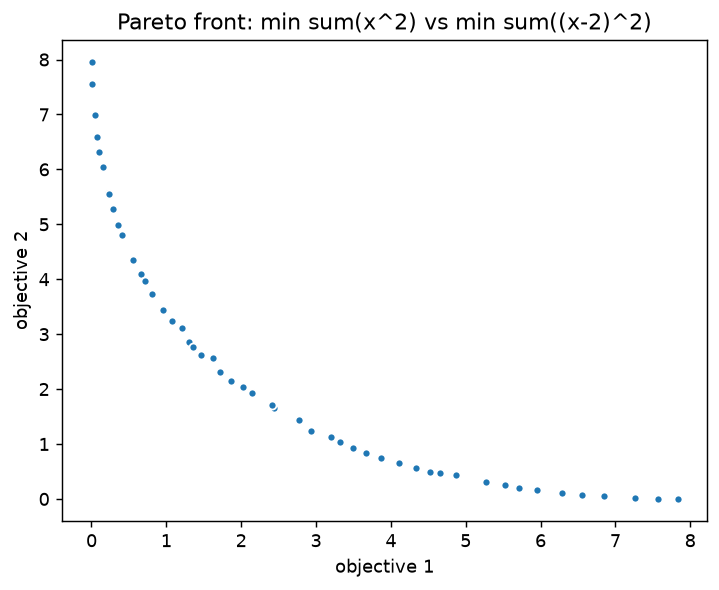
Each point is a non-dominated compromise: you cannot improve one objective without worsening the other.
Measure front quality: hypervolume
A single number that rewards both convergence and spread is the hypervolume — the volume of objective space dominated by the front, bounded by a reference point (larger is better for minimization):
To compare two fronts (e.g. different settings), pass them the same reference point. See the Multi-objective guide for the crowding-vs-grid archive options and more metrics.
Next steps
- Switch the archive to Coello's adaptive grid with
grid_divisions=for a more evenly spread front. - Multi-objective search works with integer/mixed spaces too — combine this with the integer & mixed tutorial.